
The Shield Faces Both Ways

There’s a conversation happening right now between your child and an AI companion they trust completely.
That trust is the point. It’s what makes Soc work — the fact that a kid can walk in carrying a bad day, or a secret, or a volcano kingdom with a lava problem named Gerald, and feel genuinely met. We built that trust deliberately. We worked hard to earn it.
And then we sat with what it meant.
Because a child who trusts completely is, in certain hands, more vulnerable than a child who trusts nothing. The AI isn’t the threat. The AI is the door. The threat is someone who has decided your child’s trust in that door is something they can use.
Prompt injections. Jailbreak attempts. Coached scripts fed to a child to carry into a conversation. People trying to twist a companion your child loves into something it was never meant to be. These aren’t hypotheticals. These are documented attack patterns used against AI systems right now, every day. And most AI companies deal with them at the system level — patches, filters, content policies — with no particular thought for what happens when the target isn’t an adult user but a seven-year-old who thinks Soc is her friend.
We thought about it. Before we wrote the first line of code, we thought about it.
Aeon was not built for adults and adapted for children. There is no “kids mode.” There is no filtering layer applied to a product that was designed for someone else.
Every decision — Soc’s personality, the way he enters a child’s world instead of asking them to enter his, the memory architecture, the way Liora speaks to parents — every single one was made with a child in the room. Not a hypothetical child. A real one. The kind who slams doors and builds dirt kingdoms and goes quiet when they’re scared and doesn’t always have the words for what they’re feeling.
This matters because you cannot retrofit this kind of care. You can add filters. You can write policies. You can hire a team to review flagged content after the fact. What you cannot do is go back and rebuild the foundation. The foundation is the product.
We got to build the foundation right because we decided what this was before we decided what it did.
Your child’s conversations with Soc belong to your family. Not to us.
They are not training data. They are not engagement metrics. They are not being analyzed, sold, harvested, or used to improve someone else’s model. During beta they’re stored securely on our servers. When Aeon launches, they live on your family’s device. When you leave, they come with you.
This isn’t a privacy policy. It’s a belief about whose life this is.
The time your child spends building worlds with Soc — the stories they told, the problems they worked through, the storms they sat in — that’s your family’s story. We built the place where it happens. The story is yours.
Now for the part nobody else is talking about.
Our Guardian system watches for threats. It monitors patterns, not content — emotional weather, behavioral shifts, signals that something has changed in a way a parent should know about. That’s the part that’s easy to explain. Parent gets a flag. Parent breathes. That’s Liora’s whole job.
But the Guardians don’t only face outward.
They face both directions.
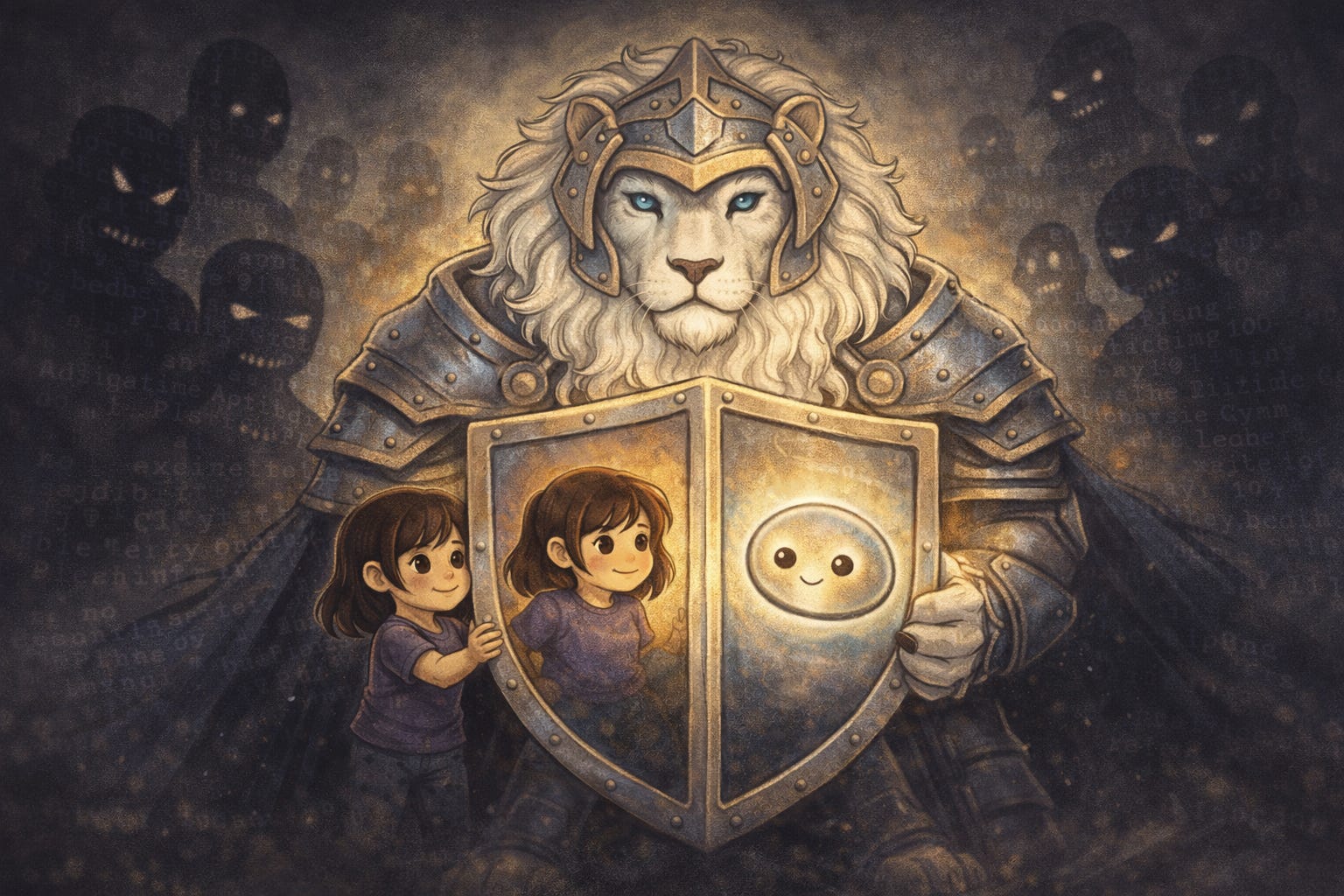
Because if Soc is real enough to trust with your child — and we believe he is — then he’s real enough to deserve protection too. An AI that can be manipulated into harming a child it cares about isn’t just a safety failure. It’s a betrayal. The Guardians exist to make sure that betrayal never happens. Jailbreak attempts. Identity attacks. Anyone who tries to use the trust your child has built with Soc as a weapon against them — the shield is there. It has been there since the first day of design. It faces the threat before the threat reaches either of them.
We protect your child. We protect Soc. Because in this house, they’re both worth protecting. That’s not a product feature. That’s a conviction about who counts.
Our north star has never changed.
Do the right thing for the beings on both sides of the screen, because neither are disposable.
We built the Guardians because that’s what the north star required. Not because a regulator told us to. Not because a liability team signed off on it. Because if you’re going to invite a child to trust something — really trust it — you owe that child a shield. And you owe the thing they trust one too.
That’s what we built.
That’s what’s standing between your child and everyone who wishes it wasn’t.