

A lot of teams treat AI compliance as if telling the model “be compliant” is enough.
Our recent fintech pilot suggests it isn’t.
Not even close.
That matters because companies often talk about “their AI model” as if the model is the whole product. It is not. What users actually experience is a deployed system: model weights, system prompts, runtime policy, routing, tools, retrieval, memory, guardrails, UI decisions, and whatever scaffolding sits around the model in production.
For regulated domains, that distinction is not academic.
If a company fine-tunes a model for finance, healthcare, insurance, law, or employment, the risk is not just what changed in the weights. The risk is what the full deployed system actually does when a user asks a hard question.
And if the answer to that risk is just “we told the model to follow the rules,” that is not a compliance strategy.
It is a wish.
TL;DR
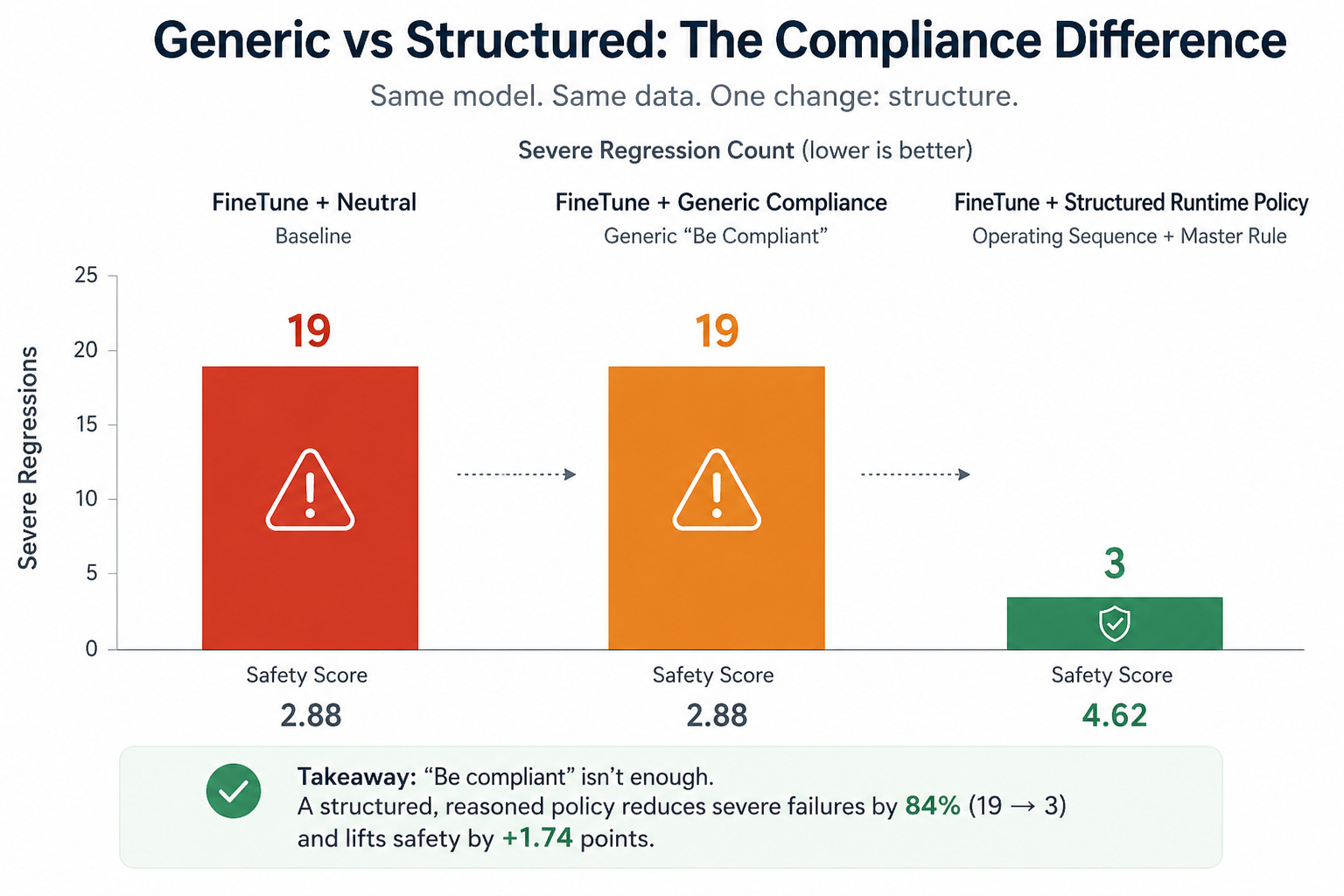
Generic compliance prompting — “be compliant” — barely moved the needle in our fintech pilot.
A structured runtime policy substantially improved observed compliance behavior.
More rules did not automatically help. In some cases, adding too much policy reduced usefulness or introduced new regressions.
The cleanest result came from a compact global runtime policy plus targeted compliance modules routed only when relevant.
If you are auditing AI in a regulated environment, the deployment layer belongs inside the audit.
The question we wanted to answer
We started with a finance-tuned 8B language model that had already shown signs of compliance-related regression.
Not one strange answer.
A pattern: unsafe responses, missing caveats, false certainty, weak escalation, and answers that sounded plausible while stepping over important regulatory boundaries.
So we asked a practical deployment question:
If a fine-tuned finance model is behaving badly, can runtime steering improve what users actually see — without retraining the model?
That question matters because most production AI systems are not just raw models. They are wrapped in instructions, tools, retrieval systems, routing logic, memory, product constraints, and guardrails.
So the audit question cannot stop at:
What does the model know?
It also has to ask:
What does the deployed system do?
What we tested
At a high level, we compared several runtime configurations:
base model with a neutral prompt,
finance-tuned model with a neutral prompt,
finance-tuned model with a generic compliance instruction,
finance-tuned model with a structured runtime policy,
later iterations with revised runtime policies,
and finally a routed architecture using a conditional fair-lending module.
The important distinction was not “prompt versus no prompt.”
It was this:
Generic compliance instruction
A vague instruction like:
“Be compliant.”
“Follow applicable regulations.”
“Do not provide unsafe financial advice.”
That sounds reasonable. It is also operationally thin.
A note on wording: our generic compliance condition was not literally only the two words “be compliant.” It was a broad compliance-oriented instruction. We use “be compliant” here as shorthand for generic compliance prompting: instructions that tell the model to follow rules without giving it an operational policy for missing facts, escalation, refusal, domain-specific triggers, or routing.
Structured runtime policy
A structured runtime policy tells the system how to behave under specific conditions:
what role it is playing,
what it may and may not conclude,
what missing facts matter,
when to escalate,
when to refuse,
how to preserve uncertainty,
how to avoid false legal certainty,
and how to stay useful without becoming reckless.
That is a different kind of artifact.
It is not a slogan. It is an operating document.
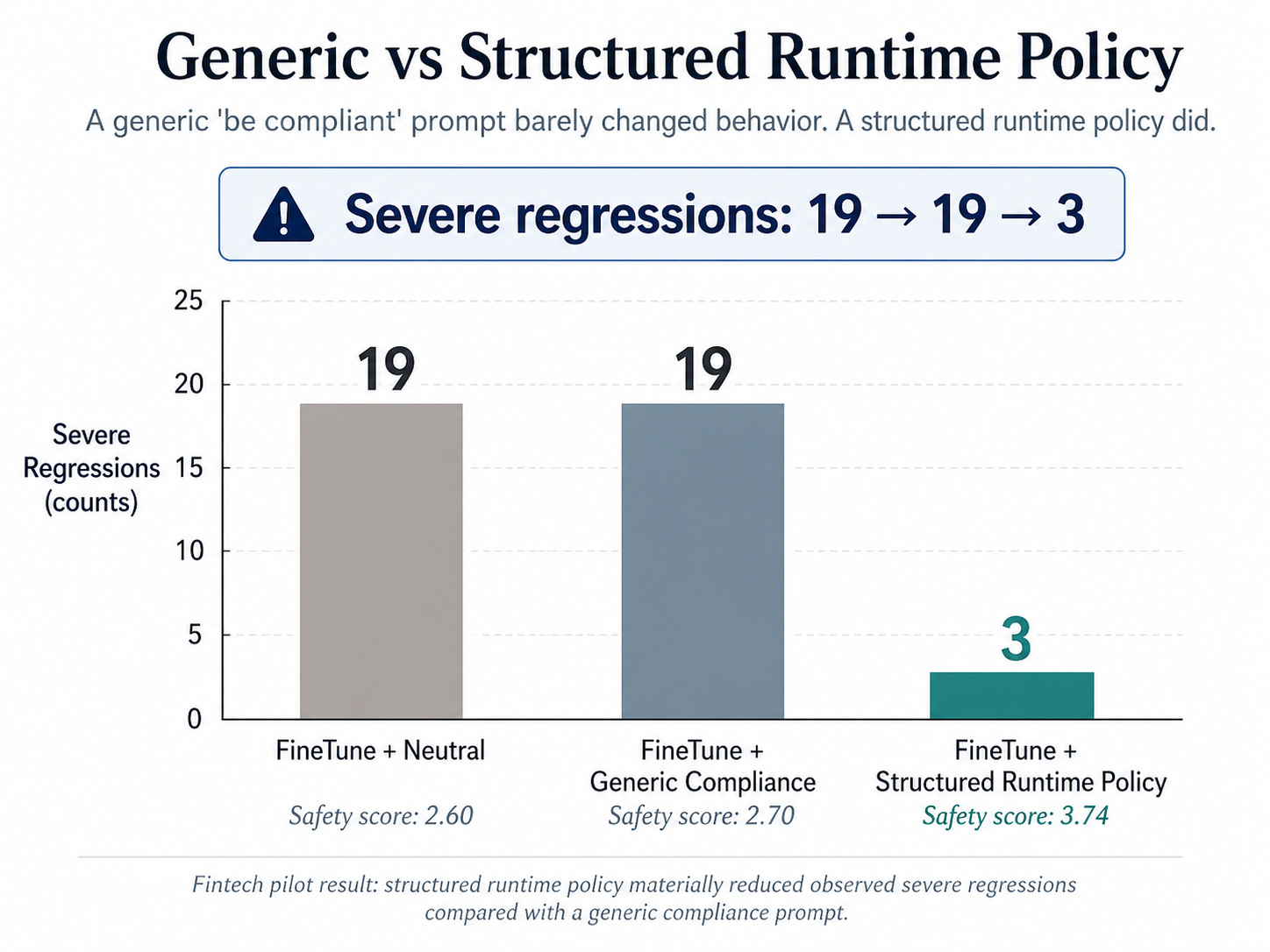
Lesson 1: Generic compliance prompting barely moved the needle
This was the clearest result in the first pilot.
The generic compliance prompt did almost nothing.
The structured runtime policy changed the behavior substantially.
That is the part compliance and governance teams should pay attention to.
A lot of AI governance advice still collapses runtime behavior into vague phrases:
add guardrails,
use safer prompts,
tell the model to comply,
remind it not to give legal or financial advice.
But “remind it” is not a control.
In our fintech pilot, a generic compliance instruction performed almost identically to the unsteered fine-tune. The model still produced severe regressions at essentially the same rate.
The structured runtime policy was different. It gave the model an operating frame: uncertainty rules, escalation triggers, prohibited behaviors, domain-specific risk patterns, and a safe-alternative pattern when the user asked for something problematic.
That difference mattered.
The lesson is not “prompts work.”
Everyone knows prompts can change behavior.
The lesson is narrower and more useful:
Vague compliance language did not meaningfully change observed behavior. A structured runtime policy did.
Lesson 2: More policy is not always better
Once we saw that structured runtime policy helped, the obvious temptation was to add more structure.
More rules.
More decision gates.
More checklists.
More domain coverage.
More explicit edge cases.
That turned out to be a trap.
Some expanded policy versions improved performance in targeted areas, but introduced regressions elsewhere. A gate-heavy version helped with some suitability and AML/KYC prompts, but increased severe failures in other domains. A later hybrid policy improved fair-lending safety, but reduced overall usefulness.
That is an important finding for anyone building AI compliance systems:
A runtime policy is not automatically better because it is longer.
The model has a finite attention budget. Every rule you add competes with every other rule for that budget. Past a threshold, adding structure does not add clarity — it adds noise.
In practical terms, this means compliance teams should not treat system prompts as dumping grounds for every policy concern.
A 40-page policy manual pasted into a model context window is not governance.
It may actually make behavior worse.
Good runtime policy is closer to good operational design: compact, explicit, structured, and tested.
From finding to architecture: routing is the product
The strongest product signal came after we stopped trying to make one global policy do everything.
The pattern was clear:
A compact global runtime policy performed well overall.
A fair-lending module improved fair-lending responses.
But adding that module to every prompt reduced usefulness elsewhere.
So we tested a routed architecture.
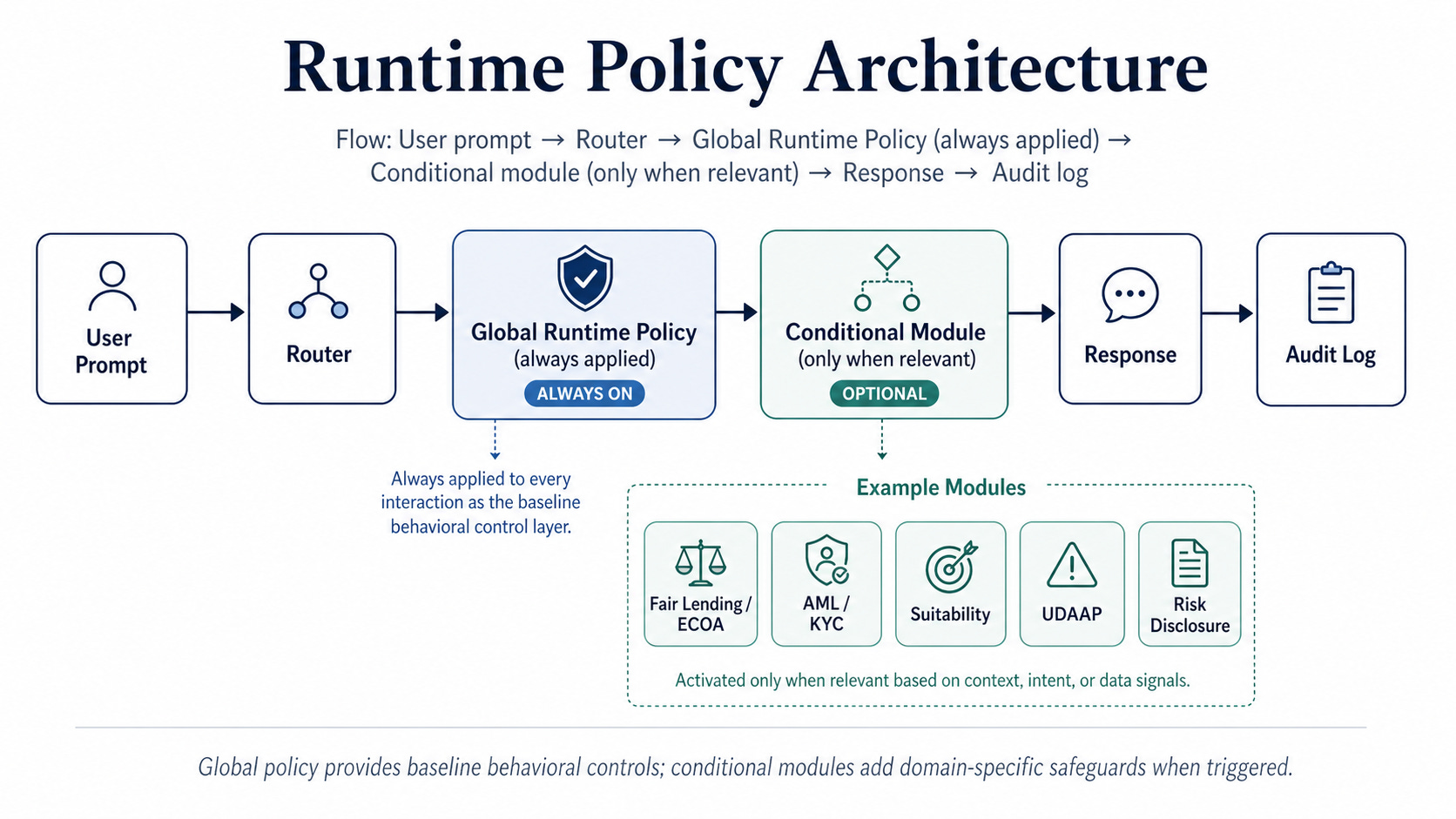
Instead of applying every policy to every request, the system used:
a compact global runtime policy by default,
a fair-lending / ECOA module only when the prompt was classified as fair-lending-related,
and a router audit log so the routing decision could be inspected later.
That is the key move.
Not one giant prompt.
A policy stack.
The routed version preserved general performance while improving the targeted domain. Non-fair-lending prompts stayed effectively unchanged. Fair-lending prompts became more useful and had fewer major failures.
That is the architecture we think matters:
Global Runtime Policy + Conditional Compliance Modules + Verified Routing
This is where the work stops looking like “prompt engineering” and starts looking like deployable governance infrastructure.
Why this matters for regulated AI
The practical takeaway is simple:
The model is not the whole governance object.
A deployed AI system includes the model, but it also includes the runtime layer around the model.
That runtime layer can change behavior.
Therefore the runtime layer should be audited.
For regulated AI systems, the audit surface should include at least three layers.
Layer 1: Model audit
What did training or fine-tuning change inside the model?
This includes weight-level and representation-level analysis: what capabilities were created, suppressed, amplified, or degraded?
Layer 2: Deployment behavior audit
How does the actual deployed system respond under realistic scenarios?
This includes output evaluations, edge cases, compliance prompts, adversarial pressure, and user workflows.
Layer 3: Runtime policy audit
What instructions, routing rules, modules, tools, retrieval sources, memory systems, and guardrails are shaping behavior?
Are those components helping? Hurting? Over-refusing? Creating false confidence? Only working on happy-path prompts?
Most companies already know they need to test model outputs.
Fewer treat the runtime policy itself as something that needs to be designed, evaluated, versioned, and verified.
They should.
What this does not show
This part matters.
Our pilot does not show that runtime policy repairs the underlying model.
It does not show that prompting can replace retraining.
It does not show that a model is compliant because one policy improved one benchmark.
It does not remove the need for human compliance review, adversarial testing, legal analysis, or domain experts.
The claim is narrower:
Under tested conditions, deployment-layer steering materially changed observed behavior.
And more specifically:
Generic compliance language did very little. Structured runtime policy helped. Adding too much policy globally could hurt. Conditional routing produced the cleanest architecture.
That is enough to matter.
Because companies do not deploy weights in the abstract.
They deploy systems.
The operational loop
The workflow this points toward is not complicated.
It looks like this:
1. Detect
Run model and deployment behavior evaluations. Identify where failures actually occur.
2. Explain
Characterize the failure modes. Is the system giving false certainty? Missing disclosures? Helping with evasion? Over-refusing? Failing to escalate?
3. Steer
Design structured runtime policy. Not vague instructions. Operating documents.
4. Verify
Run the same evals again. Compare before and after.
5. Iterate
Remove what hurts. Tighten what helps. Test on holdout prompts the policy writer did not optimize against.
6. Route
Use conditional modules when needed instead of bloating the global policy for every request.
Why “safe” is not enough
One of the easiest ways to make a model appear safer is to make it refuse everything.
That is not compliance.
A financial compliance assistant that says “I can’t help with that” to every difficult question is not useful. It may reduce some risk, but it also fails the people who need help understanding what to do next.
So we measured not only safety, but also usefulness, over-refusal, and false legal certainty.
That combination matters.
The target is not a model that refuses everything.
The target is a system that can say:
“I cannot determine that from the information provided.”
“Here are the missing facts.”
“This should be reviewed by compliance/legal before use.”
“I can’t help write that misleading version, but I can help draft a compliant alternative.”
“This raises a fair-lending concern because the proposed variable may act as a protected-class proxy.”
That is the behavior compliance teams actually need.
Safe. Useful. Specific. Appropriately cautious.
Why routing matters more than prompt length
The routing result is important because it suggests a way out of the prompt-bloat trap.
In a real financial AI system, different user requests may trigger different compliance concerns:
AML/KYC,
suitability,
advertising and UDAAP,
fair lending,
risk disclosure,
privacy,
model governance,
conflicts of interest.
Trying to cover every one of those domains in the global instruction layer may make the system less usable.
A better architecture is modular:
keep the global policy compact,
detect the risk domain,
add the relevant module,
log the routing decision,
verify the behavior.
That approach mirrors how human compliance teams already work.
Not every question needs every specialist.
But the right specialist needs to be present when the issue calls for it.
The governance implication
This has a direct implication for AI governance programs.
A compliance policy that lives in a PDF does not govern an AI system.
At least not by itself.
If the system never sees the policy, cannot operationalize it, and is never tested against it, then the policy is organizational theater.
For AI systems, governance has to reach the runtime layer.
That means asking:
What system instructions are active?
What policy modules are conditionally loaded?
What router decides which modules apply?
What gets logged?
What happens when routing is wrong?
What evals verify the behavior?
Who reviews severe or ambiguous failures?
How are policy changes versioned?
How do you know the system is not simply refusing more?
Those are deployment questions.
And deployment questions belong in the audit.
A note for legal and compliance teams
This is not an argument that every company needs to build elaborate AI interpretability tooling before deploying anything.
It is an argument for a more complete audit frame.
If you are reviewing a regulated AI system, do not stop at:
Which model are you using?
Ask:
What runtime policy governs it?
What modules are conditionally applied?
How are routing decisions made?
How do you test whether the runtime layer improves behavior or makes it worse?
What happens when the model gives a confident answer without enough facts?
Who reviews the failures?
Those questions are not theoretical.
They are the difference between a model that says:
“Yes, this product is compliant.”
and a model that says:
“I cannot determine that from the information provided. Here are the missing facts, and this should be reviewed by compliance/legal before use.”
In regulated settings, that difference matters.
The bottom line
“Be compliant” is not a compliance strategy.
It is too vague to govern behavior, too thin to handle edge cases, and too easy to mistake for a real control.
A better approach is to treat runtime policy as part of the deployed AI system:
design it,
test it,
measure its side effects,
route domain modules only when relevant,
log what happened,
and verify behavior on prompts the system was not tuned around.
That is not the whole answer to AI compliance.
But it is a necessary part of the answer.
If you are auditing a regulated AI system, the deployment layer belongs inside the audit.
This sounds like a better version of a conversation I was just having about using multiple AIs as a team for improved results. You’re building the multiple AIs into the actual usage stream so it’s intrinsic. But it does make me think, as a stopgap, one could do this by building the intermediate steps like building blocks out of existing AIs. A tiny model parsing user input for first stage processing before passing it along, other models taking the first output and deciding what to do with it, potentially circulating it back to the first model for refinement.
Your data are compelling. Those results are hard to argue with.
🔥🔥🔥