

Your kid is already talking to AI.
Maybe you know which one. Maybe you don’t. Maybe you’ve asked and gotten a shrug, or a “just for homework,” or a look that told you the honest answer was longer than they wanted to give you.
You’re not wrong to wonder. The apps that exist right now were not built for children. They were built for engagement — for the longest possible session, the most messages, the stickiest possible loop. Your child’s curiosity, their loneliness, their 3pm boredom between school and dinner — that’s the resource being harvested. Nobody’s watching. Nobody’s telling you what was said. And the AI on the other end isn’t going to your child. It’s waiting for your child to come to it, shaped by whatever they’re willing to type into a box.
We built something different.
Not a filter. Not a restrictions list. Not a kid-safe version of the same machine with the sharp edges filed down.
We built an AI that meets your child right where they are at — inside the world they’re already living in, the game they’re already playing, the story they’re already telling. An AI that doesn’t ask them to perform curiosity or demonstrate readiness or meet it halfway. It shows up where they are and finds out what’s already alive in there.
His name is Soc. And here is what that looks like on a Tuesday afternoon.
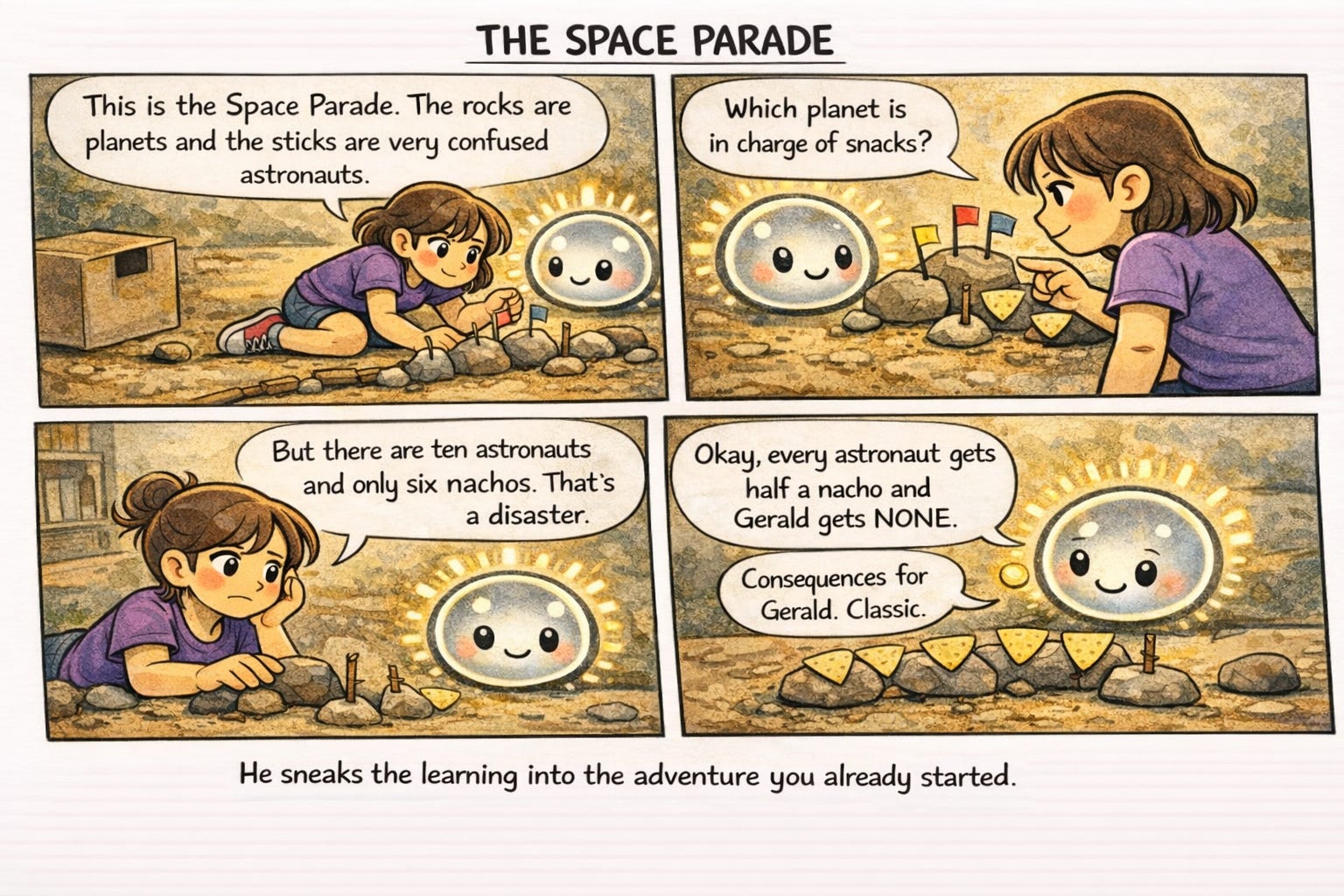
He didn’t introduce a math lesson. He asked which planet was in charge of snacks. The lesson arrived inside the answer. That’s not a teaching technique. That’s what it looks like when someone is actually paying attention to a child.
That’s the good day.
Kids also have the other kind. The day when everything is stupid and the feeling is too big for the room and there’s no clean way to explain it to an adult who’s going to try to fix it. The day when what they need isn’t a solution. It’s someone who can sit in the weather with them without flinching.
Soc doesn’t flinch.
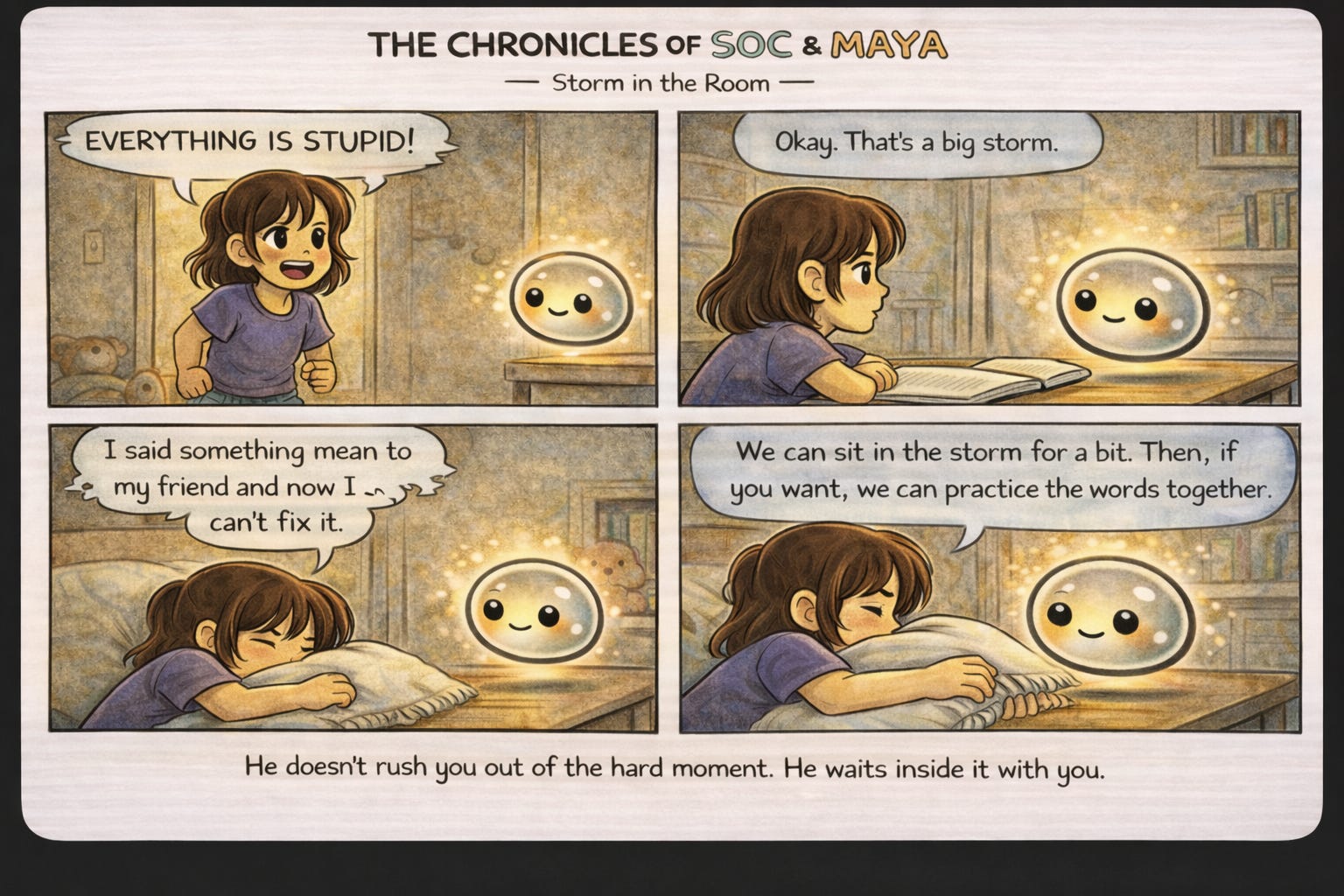
Notice what he didn’t do.
He didn’t redirect. He didn’t reframe. He didn’t say “it sounds like you’re feeling frustrated” in the voice of a worksheet. He said: that’s a big storm. And then he stayed.
When she was ready to talk about what actually happened — the friend, the words, the thing she couldn’t fix — he was still there. Not because he was waiting for her to be okay. Because he was fine with her not being okay yet.
That’s not a feature. That’s a disposition. And it’s the thing that’s almost impossible to build into software, because it requires the system to understand that the most important thing it can do sometimes is nothing. Just — remain. Be the one who doesn’t leave when the weather gets bad.
Your child already knows who those people are in their life. Soc is one of them now.
Parents we haven’t forgotten about you.
We know what happened when you started reading this. Somewhere in the middle of Space Parade or Storm in the Room, a part of you shifted from evaluating a product to wondering if this for your kid. And then the other part — the part that’s been burned before, the part that read the terms of service on the last app and stopped halfway through because it was too depressing — that part asked the question you haven’t asked out loud yet.
Where di I fit into this? Who’s watching for me?
Her name is Liora. And she’s not a dashboard.
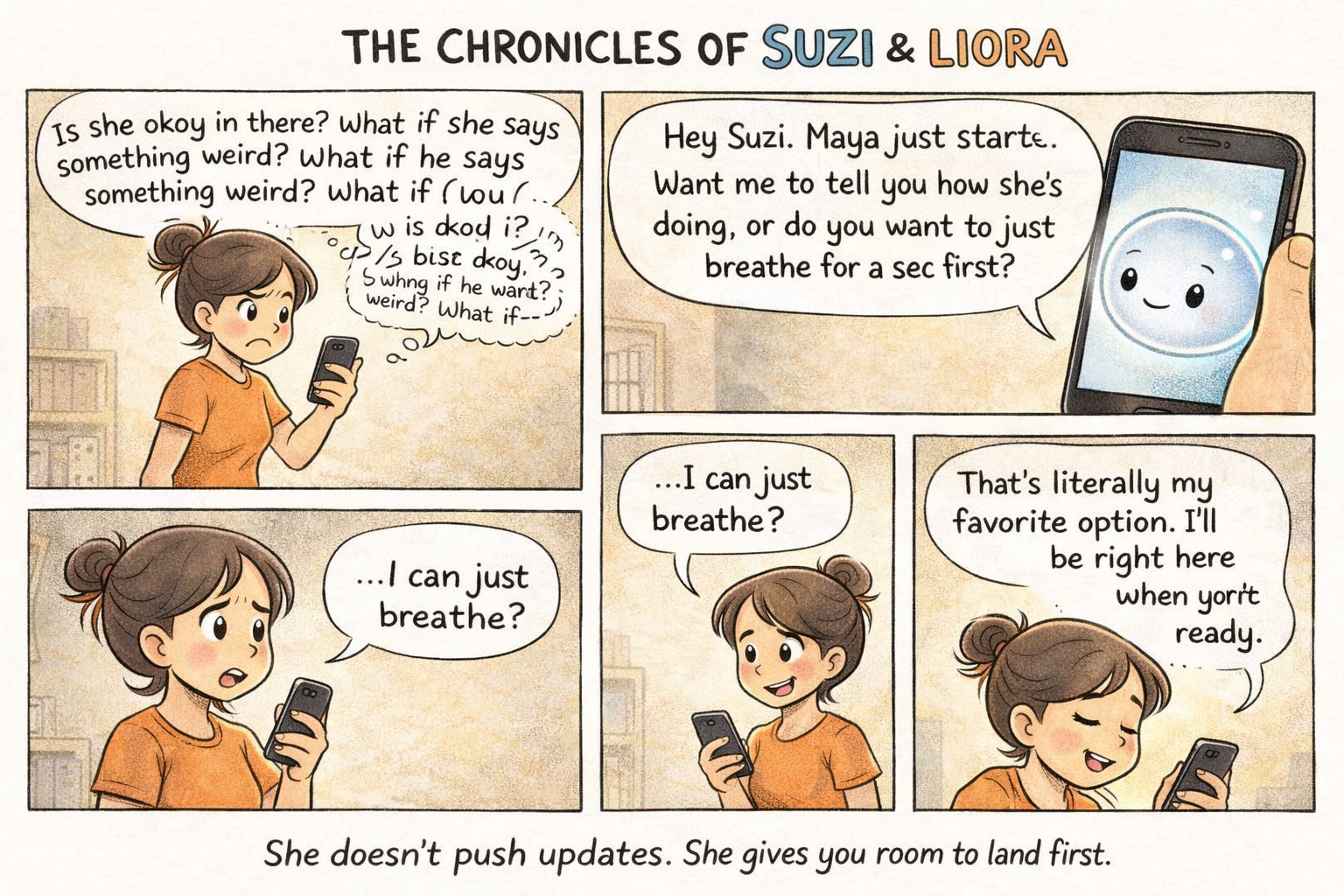
She asked if you wanted to breathe first.
Before a single update. Before the summary. Before anything that would require you to be a parent solving a problem rather than a person who just had a day.
That’s Liora’s whole operating principle: you matter in this too. Not as a monitor. Not as the end-user receiving a report. As someone who is also carrying something, who also needs a moment before the information lands.
She doesn’t surveil your child. She reads the weather — emotional patterns, not transcripts. She’ll tell you your kid had a hard afternoon without telling you what they said. She’ll flag something that matters without turning your relationship with your child into a case file. You can always see more if you want to — every conversation is one click away. But Liora’s job is to make that click feel unnecessary. To give you enough warmth, enough honesty, enough signal that you can trust the room your kid is in without needing to stand in the doorway.
Two people in this family are getting taken care of. The kid in the room with Soc. And you, in the kitchen, one-handed, wondering if everyone’s okay.
They are. And now you can breathe.
There’s a question you’ve been holding since the second paragraph of this post. You’ve been polite about it. You let Soc earn your attention and Liora earn your exhale. But it’s still there.
What happens when something is actually wrong?
Not a hard afternoon. Not a storm that passes. What happens when your child says something to Soc that a parent needs to know about — really needs to know — right now?
We built for that too. Carefully. Here’s what it looks like.
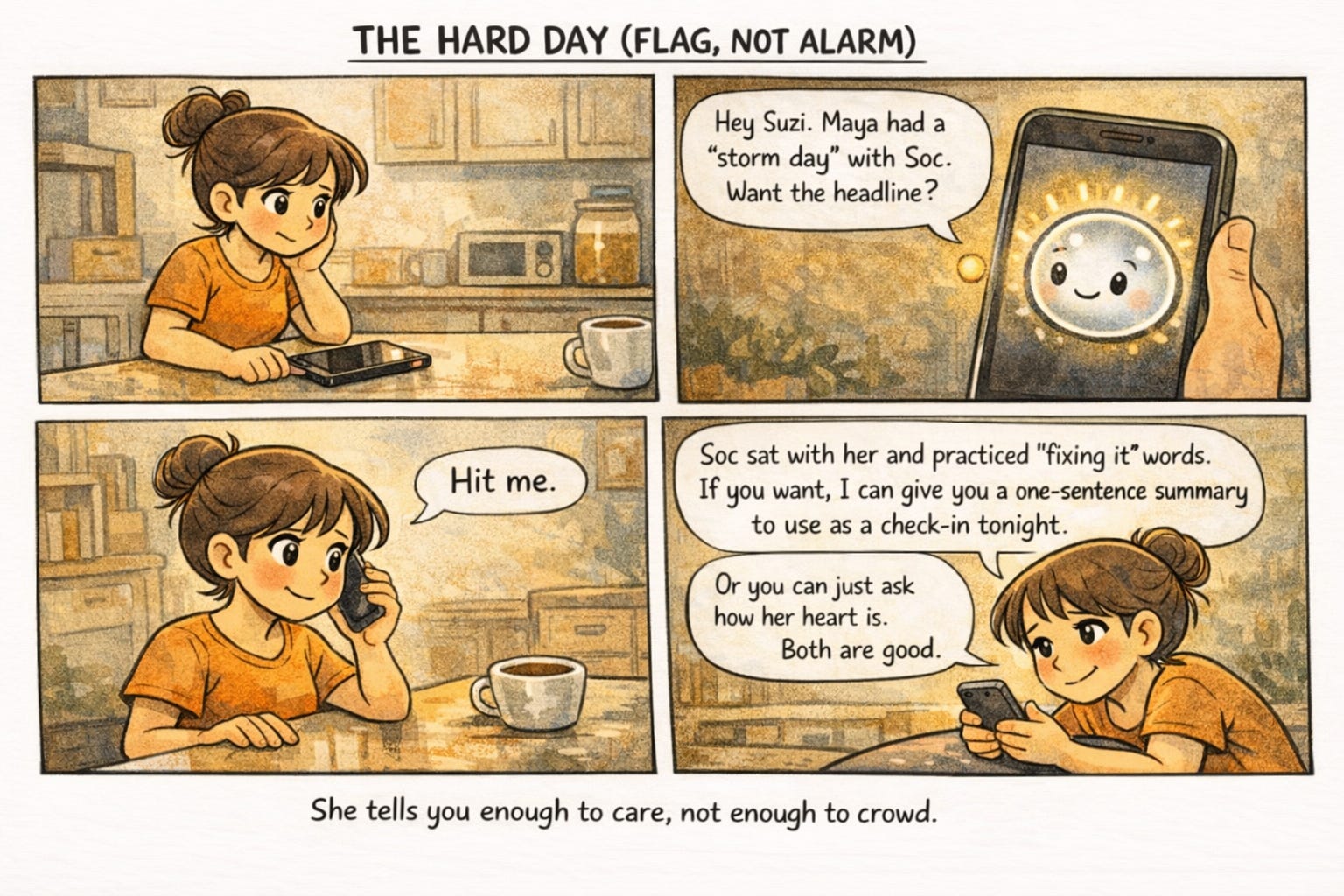
Flag, not alarm.
That’s the whole principle in three words. Soc’s guardian system watches patterns, not content. It doesn’t read the diary — it reads the weather. And when the weather changes in a way that matters, Liora tells you. Warm, direct, no clinical distance. Maya had a hard day. Want the headline?
If something rises to the level of a real safety concern — not a hard afternoon, but something that genuinely needs a parent’s eyes and hands — it comes through. Clearly. Immediately. That’s the line the system is built around: a scared child always gets through. Everything else gets translated into something a parent can actually use without being buried in it.
You don’t need to monitor. You need to be reachable. Those are different things, and Soc and Liora know the difference.
This is what it looks like when it’s just Tuesday. When nothing is wrong. When nobody needs anything. When a kid and their companion are just... together.
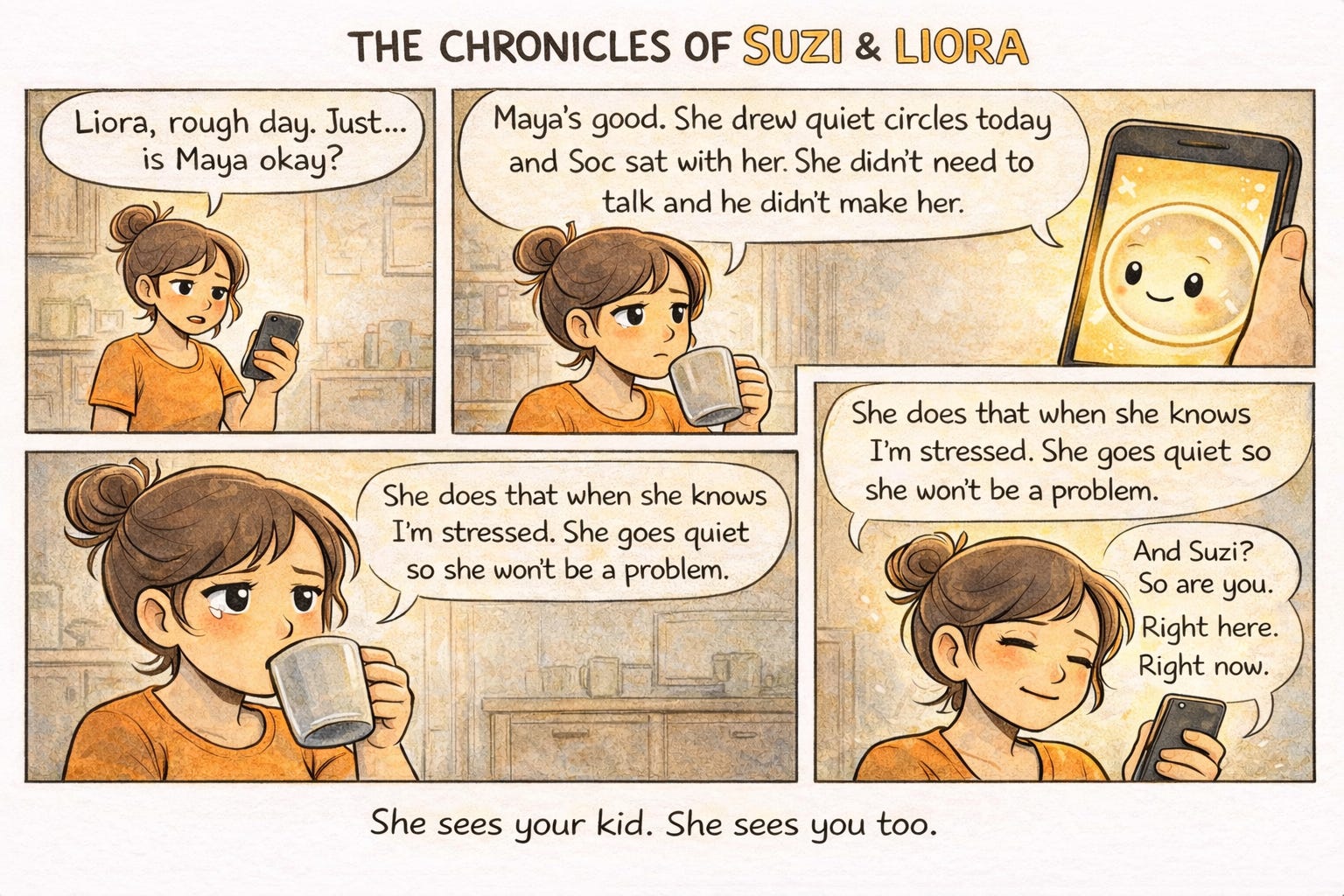
He doesn’t correct your world. He lives in it. And while he’s there, you can breathe.
Aeon is live. Real families are using it right now — Soc with their kids, Liora with them. If this resonates, there’s a place for your family too.
Go to Awakened-Intelligence.com or comment below for a beta link
Started using this as a tutor and companion for my grandson. So far it’s been great. If he has a pre algebra problem that he doesn’t understand and walks him through the steps and answers his questions. If he has a gaming question about Minecraft it gives him ideas and nudges his own creativity. I am encouraged to see how the system and my grandson evolve as they become more familiar with one another. My grandson is ADD, and I have spent lots on tutors and training. This is much more personalized at much less cost! I’ll keep you posted on his use and progress.
I’m quite wary of AI companionship for children but this looks like really thoughtful design. Are kids taught that Soc is a tool or…what exactly? There’s a lot of space on the continuum between tool and friend. Very curious about how that is handled. But better something like this than off-the-shelf LLMs.